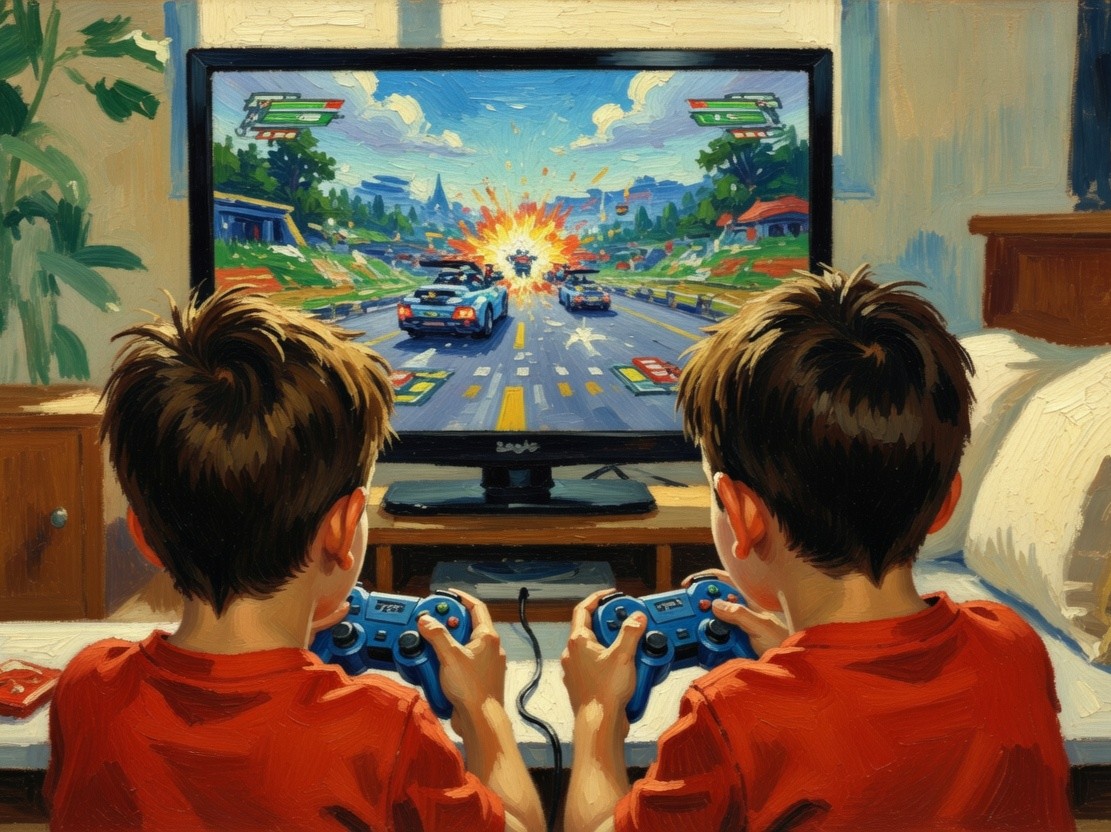
My wife and I are constantly iterating on our approach to video games for the family. We are always looking for improvement and responding to changes in our life situation. In general, we treat video games like sugar…it’s a fun treat but too much of it can make our kids unhealthy.
Here’s our strategy for video games for 2026 summed up in five guiding principles:
1.) We play video games on Sundays
Sunday is the sabbath, a day of rest, a day of celebration. As a result, we only play video games on Sundays. This contributes to making Sunday a special day for the whole family and also contributes to keeping video games as a special treat rather than an expectation.
One of the obvious results of this principle is that it limits total screen time per week. This helps to keep video games from turning into a form of escapism. Obviously, any hobby/activity can devolve into escapism, but video games seem especially prone to this. (Drawing the line between relaxation and escapism is really difficult. I would love to explore this in an article in the future.)
2.) We play video games together
We have one TV in the house and it is kept in the living room. We have one video game console in the house and it is kept in the living room. As a result, when we play video games, we never do it alone. Playing video games is always a family activity.
I feel like one of the dangers of video games growing up was the isolating effect it could have on gamers. I grew up in a house where we had televisions in every bedroom. With the benefit of hindsight, I can see the negative effects that had on me and my family. I want to avoid that with my family.
As a result, we use video games as a catalyst to spark family together time instead of allowing them to divide the family into alone time.
3.) We take turns
The kids get to rotate through hour-long turns playing whatever video games they are currently playing. The other family members watch them play, cheer them on, offer suggestions to solve problems, and sometimes join in cooperative play.
By breaking the video games into smaller turns, we increase the chances for interaction and (hopefully) reduce the chances of over-stimulation. This also contributes to the goal of playing video games together because if each child had massive, three-hour turns then the others would tune out or go do their own thing.
4.) We don’t play online
Online interactions in video games are notoriously toxic. The stories about the trash talking from 13-year-old boys in Call of Duty lobbies are infamous. (Hilarious, but not what I want for my kids.) And then there are the horror stories of adults grooming children on gaming platforms like Roblox.
Instead, when the kids want to play with someone else, they can play local co-op. They can play with their siblings, they can play with me, and they can play with their friends when they come over.
All that to say, any potential benefits of online play are just not worth the risks posed by online interactions. We only get a few years where we have the power to shelter our kids from the darker realities of the world before those grim truths need to be confronted. Kids should be allowed to enjoy the innocence of childhood for the first 10 years of their lives.
5.) We play fun games, not ugly games
As the gaming audience has aged into adulthood and beyond, games have expanded to cater to every possible demographic. While it is great to have so many options, it also means parents have to use greater judgement and discretion about which games to allow.
In our home, we generally welcome games of all genres, difficulties, and complexities. But we filter out games that are “ugly”. That generally means any games with content that is a.) gory, b.) scary, c.) sexual, or d.) unheroic. I think a, b, and c are self-explanatory. As for d, we are trying to raise little heroes and we don’t show our kids ideas or concepts that are antithetical to the values of our family.
These restrictions are rarely felt by the kids because there have never been so many options for video games as there are today. And given our limited play schedule, we often have more games than we have time to play.
Bonus: We splurge twice a year
Lastly, we “splurge” on games twice a year and let the kids play video games for the first week of summer break and the first week of Christmas break. This feels like a fitting celebration to blow off some steam, celebrate high academic accomplishment, and mark off a special time of year.
Closing thoughts
As with most things, writing this article for others might have been most beneficial to me! It forced me to coalesce the ideas my wife and I have had in sporadic conversations into clear principles.
Like I said, my wife and I are still learning. We are trying to accomplish getting the positive aspects out of gaming (fun, decision making, friendship building) while minimizing our exposure to the downsides of gaming (loneliness, over-stimulation, toxicity). So far it is working pretty well, but there is always room for improvement.
The hope is that by balancing video games with other forms of entertainment like sports, reading, board games, wrestling, etc, the kids are growing up with a wide variety of hobbies and activities they can rely on for rest, relaxation, entertainment, and socialization.
I would love to hear what best practices other families have discovered.
 English